Blog Summary
Cardiology deals with the study of the human heart, its functions and related conditions. Invasive cardiology involves minimally invasive surgical procedures using needles, fluids or catheters to treat heart problems like angioplasty and stenting. Non-invasive techniques do not involve surgery or the use of needles, fluids and catheters. Analyze and diagnose heart conditions using various tools and techniques like nuclear cardiology, echocardiography, cardiac electrophysiology, stress tests and heart monitors. Join fellowship in non-invasive cardiology course with TAU and gain the opportunity to earn around ₹1,725,000 per year.
Knowing the difference between invasive and non-invasive cardiology is the first step to explore a compelling career in the field of cardiology. If you aspire to become a cardiologist in India, this article is exclusively for you.
What Is Cardiology?
Cardiology is the branch of medicine related to the study of the human heart. As we all know, our circulatory system is a network of arteries and blood vessels. At times, irregularities in the structure and functioning of the circulatory system would make us sick and seek the attention of a heart specialist. If such a condition is left unattended for long, it could be irreparable, worse, and fatal. This is where a cardiologist comes into the picture. A qualified cardiologist uses different evaluation methods and, with the help of sophisticated instruments, identifies the problem and recommends a relevant course of treatment.
If you are aspiring to study cardiology and looking forward to setting up a career in this field knowing the key difference between invasive and Fellowship in clinical cardiology with critical care will surely help you make a well-informed career decision.
Types of Cardiology
While reading about cardiology, you will encounter terms such as non-invasive and invasive. Each procedure is different in terms of methodology and patient care. Upon taking up a career in cardiology, it would be better for you to get a clear picture of the different procedures to choose your option wisely.
Difference Between Invasive and Non-Invasive Cardiology
In invasive cardiology, a cardiologist performs minimally invasive surgery on the patient to treat his/her heart condition. This might include either angioplasty or stenting. Both procedures involve piercing the skin of the patient using perforation, catheterization, or incision and require one or a few days of hospitalization, as the situation demands. Post-operation, the patient will be advised to take complete rest for a few days and follow specific dietary restrictions.
On the other hand, a noninvasive cardiologist uses a wide range of external diagnostic methods that don’t involve needles. Therefore, there is no piercing of the skin or any other body part. A variety of Image-processing tests, like an echocardiogram, a TMT test, or a CT Scan, are done using ultrasound waves, which provide useful information about the condition of the heart.
A non-invasive procedure is especially used on patients who are diagnosed with valve diseases or those who complain of constant chest pain. These methods are risk-free and require no hospitalization in most cases. The patient can get back to his daily routine almost immediately after the procedure.
| Surgical | Non-surgical |
| Needles, fluids, or other instruments are inserted into the body to treat heart problems | No needles, fluids, or other instruments are used |
| Open or minimally invasive surgery: angioplasty and stenting | Nuclear cardiology, echocardiography, cardiac electrophysiology, stress tests, heart monitors |
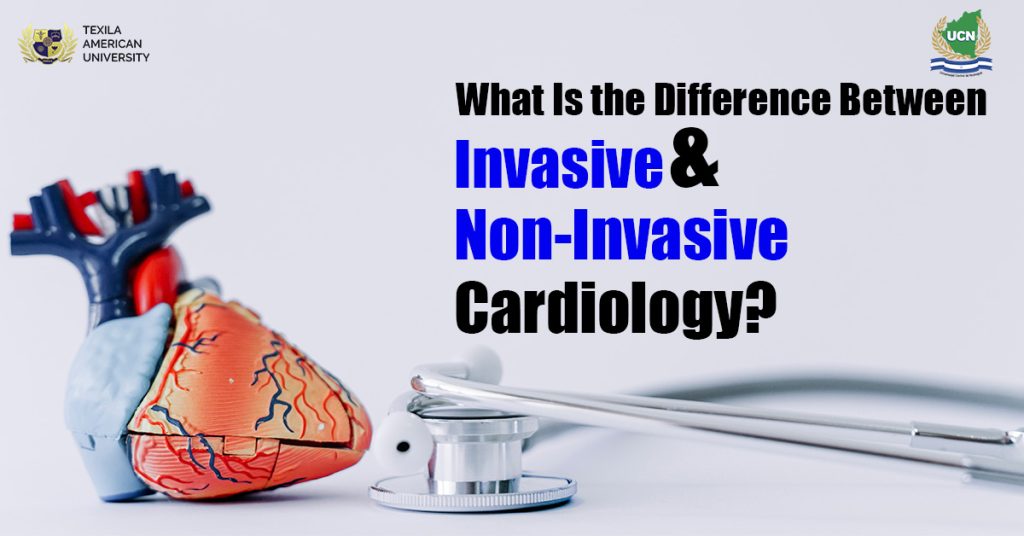
Difference Between Invasive and Non-Invasive Cardiology
As the surgeries pose certain risks, especially for hypertensive, diabetic, and older patients, it would be better for patients to take up a non-invasive procedure to find and get rid of their heart-related ailments in the initial stage.
Demand for Cardiologists in India
Cardiovascular diseases (CVDs) are becoming major reasons for deaths in India. Thus, the demand for cardio specialists is high. However, there is a huge shortage for cardiologists in India. According to a 2018 report, India needs 88,000 cardiologists but has just 4,000, which shows a huge lag.
Moreover, around 30 million people live with CVDs in India. Being one of the top countries with a high population, India needs a larger number of medical specialists, especially cardiology specialists, to treat people.
How Much Does a Non-Invasive Cardiologist Earn in India?
The salary of a non-invasive cardiologist in India is around ₹1,725,000 per year, which is high compared with the salaries of other specialties.
*Salary Source: Payscale
Non-Invasive Cardiology Fellowship Course in Texila American University
In association with the University of Central Nicaragua, Texila American University (TAU) offers a Fellowship in clinical cardiology with critical care in India. TAU is a reputed medical university with campuses in Guyana and Zambia.
As one of the top private universities, TAU’s priority is to bring a revolution in international education in the field of medicine. To accomplish this, TAU has collaborated with some of the top-rated cardiac hospitals in India. This course features a unique hands-on training module. Through our intensive and well-designed curriculum, TAU aims to prepare our students for an immensely satisfying and lucrative career in this lucrative sector.
Are you:
- An MBBS graduate from a recognized university?
- Registered with a recognized Medical Council?
- Aspire to become a non-invasive cardiologist?
If your answer is yes, TAU’s 2-year non-invasive cardiology fellowship is perfect for you.
Outstanding Teaching Methodology
TAU’s fellowship in non-invasive cardiology in India constitutes a perfect balance of theoretical and clinical components. The curriculum is designed to allow students to gain expertise in non-invasive procedures.
TAU’s Fellowship in clinical cardiology with critical care in India is a hospital-based course that gives hands-on training to prepare you for an exciting career as a non-invasive cardiologist, with utmost confidence. During the course, you will be mentored by the head of the Department of Cardiology. Besides, you will get support from TAU’s student mentors and academic coordinators throughout the course.
Now, you must have a basic understanding of the difference between invasive and non-invasive cardiology. Generally, it takes years to become a cardiologist in India. Becoming a non-invasive cardiologist with TAU is easy, and you can complete your course in just two years. Enroll in TAU’s non-invasive cardiology fellowship and achieve your dream with ease.